
Last updated: 13 November 2026. Fitrana amounts change every Ramadan; the figures below are the official 2026 rates, and this page will be updated when the 1448 AH (2027) rates are announced.
Fitrana, properly Zakat al-Fitr or Sadaqat al-Fitr, is a small compulsory payment due from every member of a Muslim household at the end of Ramadan, paid before the Eid ul-Fitr prayer. For Ramadan 2026, Pakistan’s Council of Islamic Ideology set the minimum at Rs 300 per person, based on wheat flour, with higher amounts of Rs 1,100 (barley), Rs 1,600 (dates) and Rs 3,800 (raisins).
This guide covers the amount, who pays for whom, the deadline, and where fitrana can go. For annual Zakat on wealth, which is a different obligation, see our plain guide to Zakat, Sadaqah and Sadaqah Jariyah.
In short
- Fitrana is due for every household member, young or old, including children and newborns.
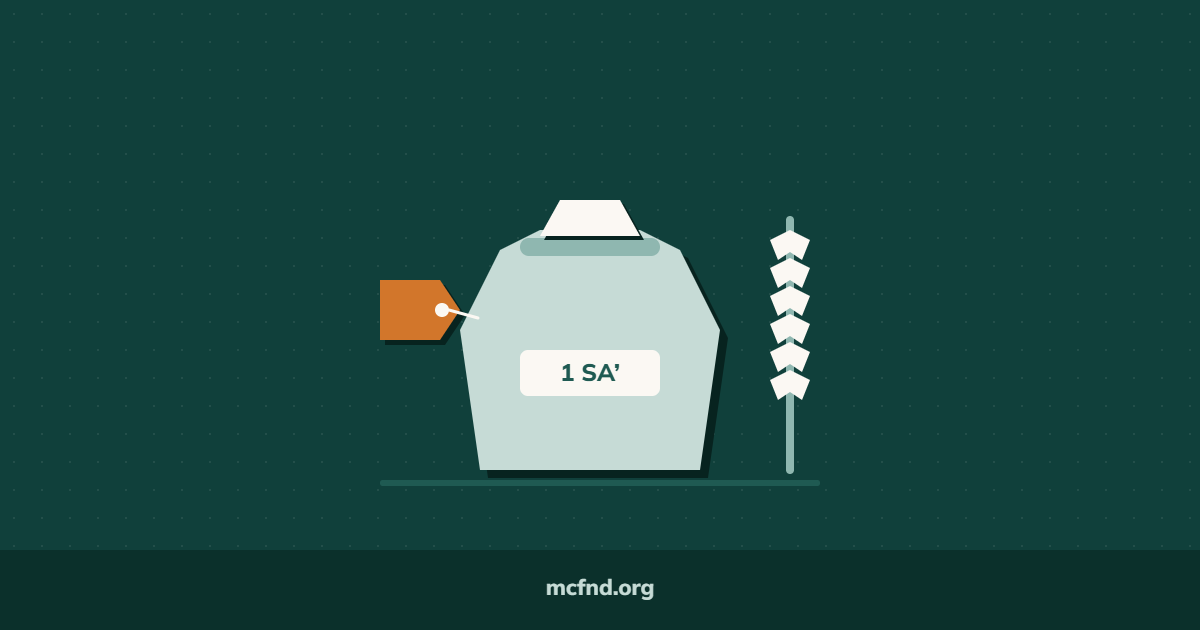
- The basis is one sa’ of staple food, about 2.25 kg of wheat in common Pakistani usage, or its cash value.
- It must reach the needy before the Eid prayer; paying earlier in Ramadan is better and widely practised.
- The head of the household normally pays for dependants.
- Recipients are the same as for Zakat: people below nisab, with the poor and needy first.
What is fitrana, and where does it come from?
Zakat al-Fitr is the charity of breaking the fast, made obligatory by the Prophet ﷺ at the end of Ramadan. Sahih al-Bukhari (1503) records that he made it compulsory on every Muslim, slave or free, male or female, young or old, as one sa’ of dates or one sa’ of barley, and ordered it paid before the people went out to the Eid prayer.
Its purpose is twofold in the scholars’ words: it purifies the fasting person from shortcomings in the month, and it ensures the poor can celebrate Eid without asking. That purpose explains the deadline; money that arrives after the Eid prayer counts as ordinary sadaqah, not fitrana.
How much is fitrana in Pakistan?
The amount is the value of one sa’ (about 2.25 kg) of a staple food, which is why there are several valid amounts, not one. Pakistan’s Council of Islamic Ideology announces rupee values each Ramadan. The 2026 announcement, reported by APP, set:
| Basis (one sa’) | 2026 amount per person |
|---|---|
| Wheat flour | Rs 300 (minimum) |
| Barley | Rs 1,100 |
| Dates | Rs 1,600 |
| Raisins | Rs 3,800 |
Three notes on using this table honestly:
- These are 2026 figures. The 1448 AH announcement, expected shortly before Ramadan 2027 (which begins around 8 February 2027, subject to moon sighting), will replace them, and prices differ by province; the Council advised using local prices outside Punjab.
- The wheat figure is a minimum, not a target. Scholars encourage those who can afford it to pay at the higher rates, since the choice of staple is meant to reflect what your household actually eats.
- Fidya, the separate payment for fasts a person cannot keep due to permanent inability, is announced alongside fitrana at the wheat rate per missed fast. It is a different obligation with its own rules.
Who has to pay, and for whom?
Every Muslim who holds the nisab beyond basic needs on Eid day owes fitrana for themselves, in the Hanafi view followed by most Pakistanis; other schools set the bar lower, at having food beyond one’s need for Eid day and night. In practice, any household that pays Zakat certainly pays fitrana.
The head of the household customarily pays for dependants: spouse, children, including a baby born before Eid, and anyone else they maintain. Count everyone. A family of seven at the 2026 wheat rate owes at least Rs 2,100.
Scholars differ on an unborn child: most do not require fitrana for a baby born after Eid begins, and many regard paying for a pregnancy as voluntary.
When exactly must it be paid?
The deadline is the Eid ul-Fitr prayer. The hadith in Sahih al-Bukhari (1503) is explicit that it be paid before the people go out to pray. Paying during Ramadan, even in its first days, is valid in the Hanafi school and is what most charities encourage, because it gives the money time to reach families before Eid.
If you are sending fitrana to Pakistan from abroad, allow for transfer time and the possibility that Eid falls a day earlier than where you live. Send by mid-Ramadan; our Ramadan giving checklist for overseas Pakistanis has the full timing plan.
Missed the deadline? The obligation is not erased; pay it as soon as possible, though its special status is lost. Do better next year by diarising it for mid-Ramadan.
Who can receive fitrana?
The recipients are the Zakat categories, with the poor and needy foremost; a person below nisab who cannot meet Eid-day needs is the classic recipient. Your own parents, children and spouse cannot receive it, the same exclusions as Zakat. The full list, with the family cases, is in our guide to who is eligible for Zakat.
Give it where it will actually be spent on Eid: a widow’s household, a labourer’s family, your mosque’s verified list, or a charity that distributes food or cash before Eid and says clearly that fitrana is kept for eligible recipients.
Cash or food?
The Hanafi school permits and often prefers cash, as the more useful form for the poor, which is why Pakistan’s official announcements are in rupees. Other schools, notably the Hanbali and the stricter Shafi’i position, hold that staple food itself should be given. Both practices exist in Pakistan; follow the school you follow in the rest of your worship, and do not criticise the other.
Where MCF fits in
Momina Cheema Foundation distributes Ramadan support in district Shigar, Gilgit-Baltistan, including the annual Ramadan ration for families, alongside our year-round work. Donations marked as Zakat or fitrana are kept for eligible recipients. If you would like your fitrana to reach families in the north, make a donation early in Ramadan and label it fitrana.
Frequently asked questions
Is fitrana the same as Zakat?
No. Zakat is 2.5% of zakatable wealth held above nisab for a lunar year, and can fall due any time of year. Fitrana is a small fixed amount per person, tied to Ramadan’s end, owed regardless of how the year went, provided you meet its threshold on Eid. Paying one does not discharge the other.
Do children have to pay fitrana?
Fitrana is due on behalf of children; they do not pay it themselves. The head of the household pays for every dependant, and the hadith explicitly includes young and old. In the Hanafi view, a wealthy minor’s fitrana may be paid from the minor’s own wealth by the guardian.
Can I pay fitrana for my parents?
If your parents are your dependants, maintained by you, many scholars say you should pay on their behalf, and it is valid with their knowledge. Independent parents owe their own fitrana. Note the direction: paying fitrana for your parents is support; giving your fitrana to your parents is not valid, as with Zakat.
What is the difference between fitrana and fidya?
Fitrana is the end-of-Ramadan payment owed per person by households above the threshold. Fidya compensates for fasts a person permanently cannot keep, due to old age or chronic illness, at roughly the wheat fitrana rate per missed fast. A temporarily ill or travelling person makes the fasts up later instead; fidya does not apply to them in most scholars’ view.
Can fitrana be sent to another city or country?
Yes, and scholars generally prefer local distribution where local need exists, while permitting sending it to greater need elsewhere, such as family regions or disaster areas. The practical constraint is the deadline: it must reach the needy before Eid prayer, so send early through official channels.
Sources
All checked on 13 November 2026.
- Sahih al-Bukhari 1503: Zakat al-Fitr made obligatory, paid before the Eid prayer
- HadeethEnc commentary on the Zakat al-Fitr hadith
- APP: Council of Islamic Ideology fixes Sadqa-i-Fitr and Fidya for Ramadan 2026
- The National: expected Ramadan 2027 dates
- MCF: Zakat, Sadaqah and Sadaqah Jariyah, the plain guide
How this guide was put together
I took the amounts from the Council of Islamic Ideology’s 2026 announcement as reported by APP, the rulings from Sahih al-Bukhari 1503 and its commentary, and noted where the schools differ rather than choosing between them, on 13 November 2026. This is general religious information, not a fatwa; for your own case, ask a scholar you trust. Kiran Yahya, Momina Cheema Foundation.